Setting Up a Feeding Station for a Yorkie: What to Look For
General nutrition information compiled from product labels and published sources, not veterinary advice. Your veterinarian is the right person to choose a diet for your dog, especially one with a health condition.
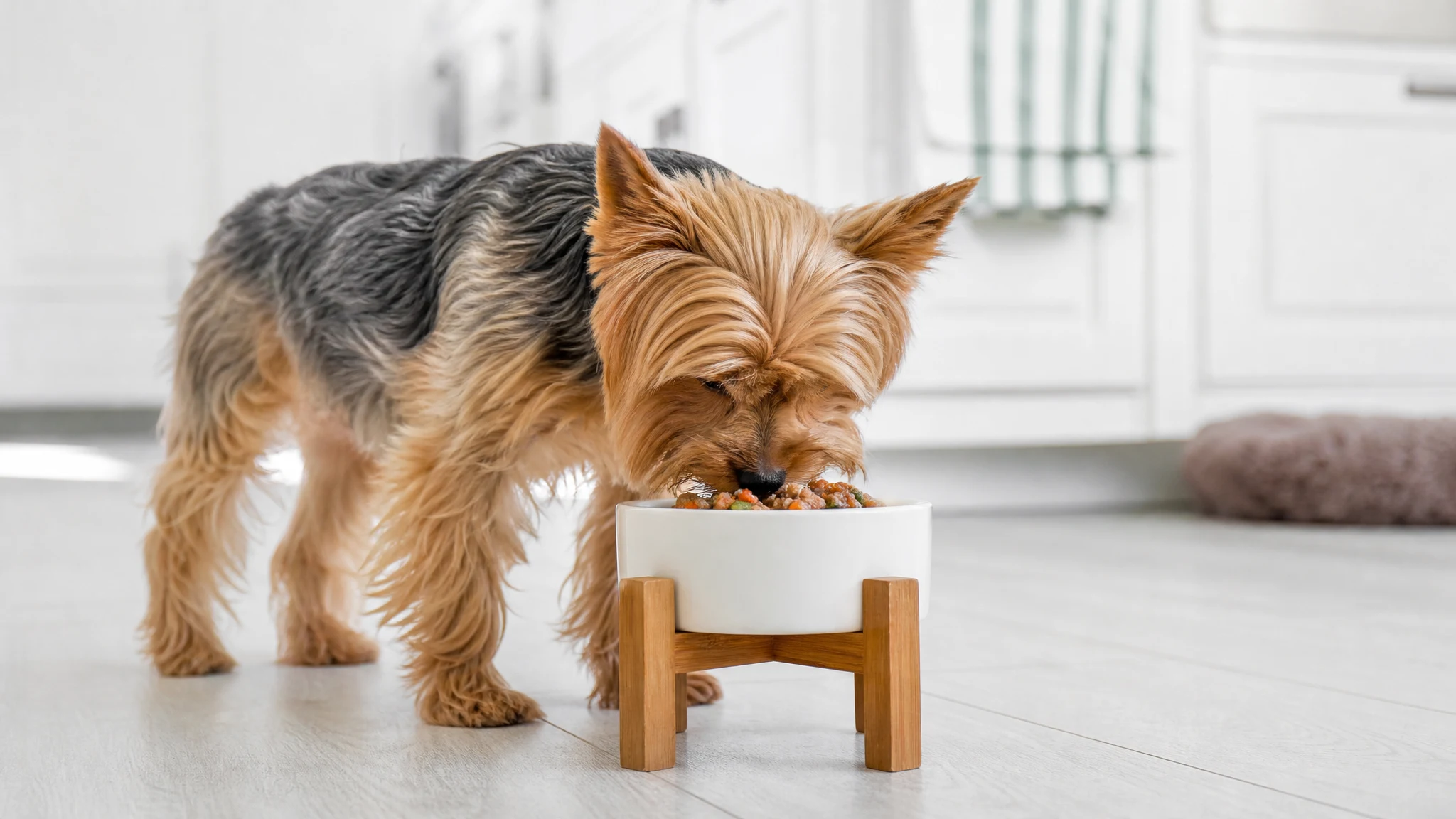
A good dog feeding station is simple. It is a quiet spot, a bowl that fits a small mouth, a way to measure food, and a routine you can repeat every day. For a Yorkshire Terrier, which the American Kennel Club places in the Toy Group, the details matter a little more because the dog is so small.
This guide walks through the setup step by step. It covers what to gather, how to place everything, and which mistakes tend to cause trouble. It does not tell you which food to buy. It does show how to read the label data that comes with the food you choose.
Why a Yorkie Needs a Planned Feeding Spot
The American Kennel Club lists the adult Yorkie at about 7 pounds, and the Yorkshire Terrier Club of America says the breed standard is that a Yorkie must not exceed seven pounds. At that size, a few extra kibbles are a large share of the day's food. The AKC also notes that some Yorkies are prone to becoming overweight, so it advises watching calories and treats.
A planned station helps with that. When food is measured in the same place at the same times, it is easier to see what your dog really eats. It also keeps meals away from foot traffic, other pets and table scraps.
The Merck Veterinary Manual reports an increased prevalence of pancreatitis in Yorkshire Terriers and says dietary indiscretion is believed to be a common risk factor in dogs. A station that keeps stray food out of reach is a practical response to that. It does not prevent or treat any condition, and your veterinarian decides what is right for your individual dog.
Materials You Will Need
- A food bowl that is shallow and light enough for a toy-sized mouth. Stainless steel, ceramic and hard plastic are all common. Pick one you can wash easily.
- A water bowl, kept next to the food bowl and refilled daily.
- A measuring cup or a kitchen scale. A scale in grams is the most exact way to portion tiny meals.
- A non-slip mat to catch spills and keep the bowl from sliding.
- A sealed container for dry food, or a covered, labelled container for opened wet food in the fridge.
- The food bag or can, or a photo of its label, so you can check the feeding guide and calorie count.
- A notebook or phone note for logging meals, treats and body weight.
Step 1: Choose a Quiet, Low-Traffic Spot
Pick a corner away from the front door, stairs and busy walkways. A Yorkie that is startled mid-meal may eat too fast or walk away and return later. A calm place helps meals stay predictable.
Choose a flat, washable floor such as tile or vinyl. Put the mat down first, then the bowls. Keep the spot away from the trash can, the pantry and any place where people drop food. If you share your home with other pets, feed them in separate areas so no one eats a neighbor's meal.
Step 2: Pick Bowls That Fit a Toy Breed
Look for these features:
- Low sides. A Yorkie has a small face and a long coat. A shallow bowl is easier to reach into than a deep one.
- A wide, stable base. A bowl that tips or slides is frustrating and messy.
- A smooth surface. Scratches and rough spots are harder to clean.
- The right capacity. A tiny meal in a very large bowl is hard to see and easy to over-pour.
Raised stands are sold for dogs of all sizes. For a toy dog, a stand is only useful if your Yorkie can still reach the food comfortably. If your dog has a neck, back or swallowing concern, ask your veterinarian before changing the bowl height.
The Yorkshire Terrier Club of America also notes the breed's long, silky coat. If the hair on the face falls into the bowl at mealtime, some owners tie it back with a small, safe topknot band. Keep it loose enough to be comfortable.
Step 3: Read the Label Before You Set Up the Portions
Whatever food you pick, the label is your starting point. Look for three things:
- The AAFCO statement. It says whether the food is complete and balanced and for which life stage, such as growth or adult maintenance.
- The calories per cup or per can. This is the number that lets you compare foods fairly.
- The feeding table. This is a starting point, not a prescription.
Here is how this looks on real brand pages. These are label data only. We compared label data and did not run feeding trials or taste tests.
| Food (brand page data) | Life stage | Calories | Example from the brand's feeding table |
|---|---|---|---|
| Royal Canin Breed Health Nutrition Yorkshire Terrier Puppy Dry | Puppy, 8 weeks to 10 months | 379 kcal ME per cup | 2 months old, 4.4 lb target adult weight: 1/2 cup (49 g) per day |
| Royal Canin Breed Health Nutrition Yorkshire Terrier Adult Dry | Adult, 10 months to 8 years | 336 kcal ME per cup | 4.4 lb dog, low activity: 1/2 cup (41 g) per day |
| Hill's Science Diet Adult Small & Mini Chicken & Brown Rice Recipe | Adult, 1 to 6 years, up to 25 lb when grown | 357 kcal per cup | 5 lb dog: 5/8 cup (60 g) per day |
Notice that the same dog weight can map to different cup amounts, because each food has a different calorie density. That is why a cup is not a universal unit. Royal Canin labels its breed formulas as puppy from 8 weeks to 10 months and adult from 10 months. Hill's labels its Small & Mini puppy food for puppies up to 1 year old. Those are brand labels, so check the one on your food rather than assuming a single switch date.
For amounts by age and weight, see our guide on how much to feed a Yorkie by age and weight.
Step 4: Set Up Your Measuring Routine
Keep the scoop or scale at the station so measuring becomes automatic. Weigh the food in grams if you can. A small scoop that is a little too full can add noticeable calories for a 7 pound dog.
If your veterinarian has given you a daily amount, use that. If not, use the label's feeding table as a starting point and adjust with your vet's guidance, based on your dog's body condition, weight and activity. The label is built for an average dog, and yours may need more or less.
Count treats as part of the day's food. If you use training treats, take a small amount out of the meal portion, or choose very small pieces. This is the simplest way to follow the AKC's advice to watch calories and treats.
Step 5: Build a Meal Schedule Around the Station
The Yorkshire Terrier Club of America advises feeding a young Yorkie puppy three to four times a day. As the dog matures, two feedings a day should be sufficient. Set a consistent clock time for each meal and keep it close to the same every day.
The club also names hypoglycemia (low blood sugar) as a concern in puppies, especially at 6 to 12 weeks old. Frequent meals are part of why the schedule matters. If a puppy seems weak, wobbly, unusually sleepy or will not eat, contact a veterinarian right away. That is a medical question, not something to solve with a feeding setup.
For an adult, offer the meal, give your dog around 15 to 20 minutes, then pick up what is left. Do not leave food out all day unless your vet recommends it. Free feeding makes it hard to notice appetite changes, and appetite is often the first sign that something is off.
Step 6: Keep Food Fresh and the Station Clean
- Wash the food and water bowls daily with hot, soapy water, and dry them.
- Store dry food in a sealed container in a cool, dry place, and keep the bag's label so you can check the formula and any best-by information.
- Cover and refrigerate opened wet food, and follow the storage directions on the can or the brand page.
- Fresh or refrigerated foods have their own handling rules. For example, Hill's says its fresh roll must be kept refrigerated below 40°F (4°C) and not frozen. Always follow the brand's own directions.
- Wipe the mat after each meal and wash it regularly.
Dental care is a separate job. A WCVM Today article from the Western College of Veterinary Medicine, University of Saskatchewan, says small dogs are much more likely than larger dogs to get periodontal disease. A clean bowl does not replace tooth care, so ask your veterinarian about a dental plan.
Common Mistakes to Avoid
- Eyeballing portions. A heaping scoop can be far more than the label intends for a toy dog.
- Skipping the treat math. Treats, chews and table bits all count.
- Using a puppy food too long, or an adult food too early. Follow the AAFCO statement on your food and ask your vet when to switch.
- Assuming a food is right because of marketing. Words like "natural" or "premium" are not a nutrition guarantee. The AAFCO statement and calorie count are more useful.
- Ignoring the large-size growth wording. Per the Merck Veterinary Manual, a growth or all-life-stages food must say whether it is for or except for growth of large-size dogs (70 lb or more as an adult). The "including" wording relates to AAFCO's level for calcium. A 7 pound Yorkie is a toy breed, so it is not a deciding factor for your dog, but you will see the phrase on labels, and it helps to know what it means.
- Changing foods suddenly. Switch gradually and ask your vet if your dog has digestive trouble.
- Adding supplements on your own. Do not add any without veterinary advice. Doses are a veterinary decision.
- Leaving food where a Yorkie can steal it. Counters, low tables and open trash cans are common sources.
When to Check With Your Vet First
Confirm amounts and food choices with your veterinarian if your dog has any health condition. The Yorkshire Terrier Club of America names portosystemic shunt and protein-losing enteropathy as known to occur in the breed, and the Merck Veterinary Manual says extrahepatic portosystemic shunts are more common in toy breeds, with Yorkshire Terriers named first. Diets for these conditions are a veterinary matter. Prescription diets are something only a veterinarian prescribes.
If your dog is a puppy, a senior, pregnant, underweight or overweight, the feeding table on a bag is only a rough guide. Ask your vet to help set a target weight and a daily amount.
What to Expect From a Good Setup
A tidy station will not change your dog's health by itself. It may, however, make mealtimes calmer and portions more consistent, and it may make it easier to notice changes in appetite or weight. Many owners find that a routine helps their dog settle into mealtimes within a couple of weeks, though every dog differs.
Weigh your Yorkie regularly, using a baby scale or your vet's scale, and write the number down. If the trend moves up or down without a plan, bring the log to your veterinarian.
Quick Setup Checklist
- Choose a quiet spot on an easy-to-clean floor.
- Set out a shallow food bowl, a water bowl and a non-slip mat.
- Read the AAFCO statement, calories and feeding table on the food label.
- Measure each meal by weight when possible.
- Feed on a regular schedule, three to four times a day for a young puppy and twice a day once the dog matures, per the Yorkshire Terrier Club of America.
- Count treats, wash bowls daily and store food properly.
- Log weight and check amounts with your veterinarian.
Sources
- American Kennel Club, Yorkshire Terrier breed page
- Yorkshire Terrier Club of America, About Yorkies page
- Yorkshire Terrier Club of America, "Your Yorkshire Terrier" brochure
- Merck Veterinary Manual, Dog and Cat Foods
- Merck Veterinary Manual, Pancreatitis in Dogs and Cats
- Merck Veterinary Manual, Congenital and Inherited Anomalies of the Liver in Animals
- WCVM Today, Detection and prevention can keep periodontal disease at bay
- Royal Canin US, Yorkshire Terrier Adult Dry Dog Food
- Royal Canin US, Yorkshire Terrier Puppy Dry Dog Food
- Hill's Pet Nutrition US, Science Diet Adult Small & Mini Chicken & Brown Rice Recipe
- Hill's Pet Nutrition US, Science Diet Puppy Small & Mini Chicken & Brown Rice Recipe
- Hill's Pet Nutrition US, Science Diet Adult Single Protein Chicken & Brown Rice Fresh Roll