Mixing Wet and Dry Food for a Yorkie: How to Do It Right
General nutrition information compiled from product labels and published sources, not veterinary advice. Your veterinarian is the right person to choose a diet for your dog, especially one with a health condition.
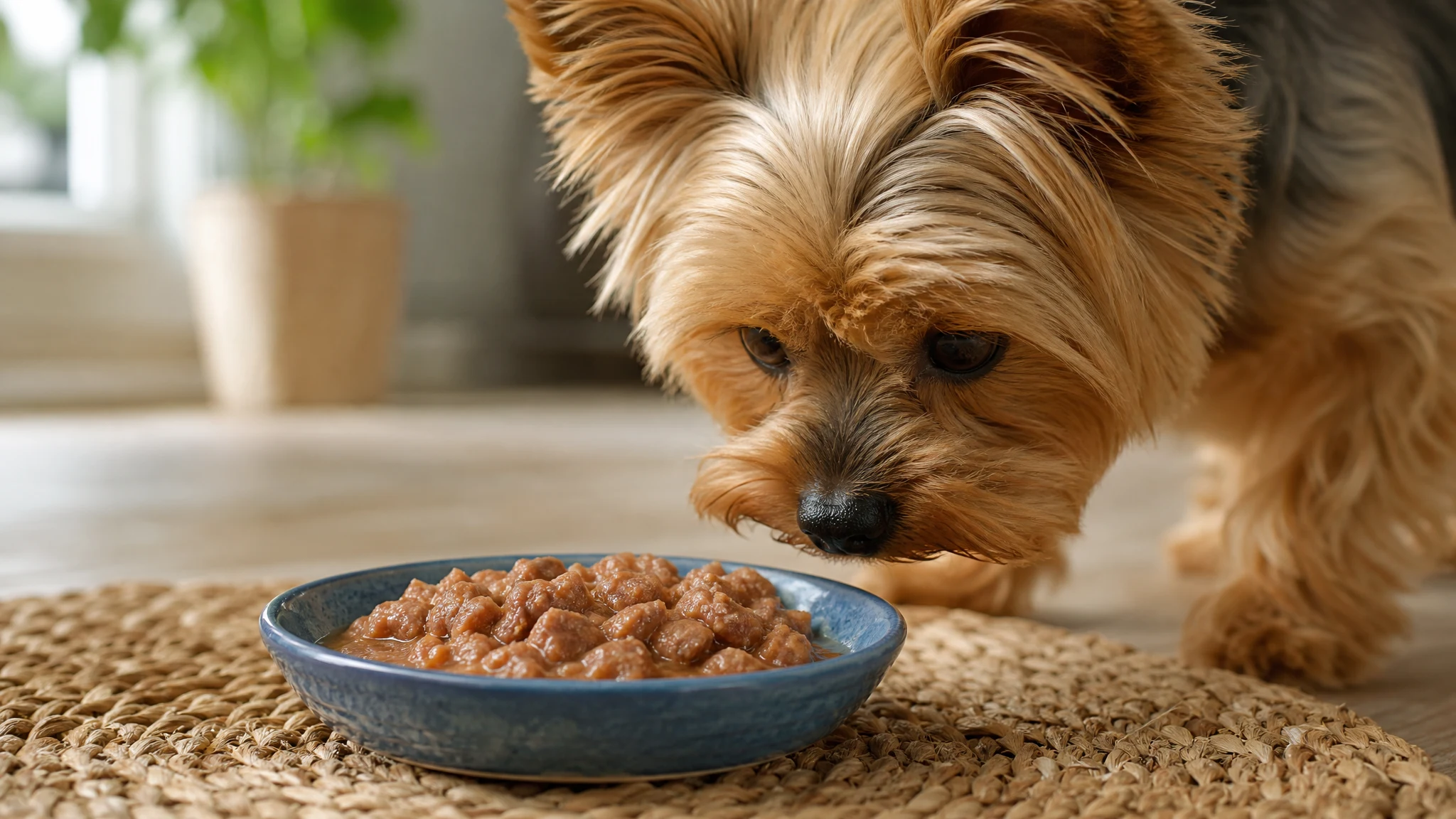
Many Yorkie owners like the idea of a bowl that has crunchy kibble plus a spoonful of wet food on top. It can make a small dog's meal more interesting. It can also quietly add calories, and a Yorkie has very little room for extra ones.
This guide walks through dog feeding preparation for a mixed bowl, one step at a time. The goal is simple: keep the total food for the day at a sensible level while you combine textures.
A note on method. We compared label data from brand pages. We did not run feeding trials or taste tests, so nothing here says one food works better than another for your dog.
Why calories matter more than texture for a Yorkie
The American Kennel Club places the Yorkshire Terrier in the Toy Group. It lists an adult weight of about 7 pounds. The Yorkshire Terrier Club of America says the breed standard is that a Yorkie must not exceed seven pounds.
On a dog this small, a few extra spoonfuls make up a large share of a day's food. The AKC notes that some Yorkies are prone to becoming overweight, and it advises owners to watch calories and treats. A mixed bowl is the kind of habit where that advice applies directly.
So the main rule is this: wet food added on top is not a free extra. It replaces part of the dry food, not sits beside it.
What you need
- A dry food and a wet food that both state they are complete and balanced for your dog's life stage. Look for the AAFCO statement on the label or brand page.
- Both foods' calorie figures (kcal per cup, and kcal per can or per ounce).
- The feeding table from each package.
- A kitchen scale or a proper dry measuring cup. A scoop from the bag is not a measurement.
- A can-sized spoon or a quarter-can measure for wet food.
- A covered container and fridge space for opened wet food.
- A notebook or phone note to record what you feed each day.
Step 1: Choose two foods that suit the same life stage
Pick a dry and a wet food made for the same stage, such as puppy with puppy or adult with adult. Staying with one brand line makes the math easier, though it is not required.
Check the stage wording on the brand page. Royal Canin labels its Yorkshire Terrier formulas as puppy for 8 weeks to 10 months and adult from 10 months. Hill's labels its Small & Mini puppy food for puppies up to 1 year old. These are brand labels, not a rule from a vet school or the breed club, so the switch timing is a good question for your veterinarian.
Also read the AAFCO statement. A food labelled for maintenance is for adults. A growth or all-life-stages food has a statement about large-size dogs. According to the Merck Veterinary Manual, the wording "including growth of large-size dogs" only means the food meets AAFCO's calcium level for large growing dogs. The Yorkie is a 7 pound toy breed, so that wording is not a sign of a food made for your dog.
Step 2: Write down both foods' calories
Calories per cup or per can are the only fair way to compare a dry food and a wet food. Cups and cans are not the same size. Here are a few examples taken from the brands' own product pages:
| Food (brand page) | Form | Calories listed |
|---|---|---|
| Royal Canin Yorkshire Terrier Adult | Dry | 336 kcal ME per cup |
| Royal Canin Yorkshire Terrier Adult Loaf in Sauce | Wet | 81 kcal ME per can (can size not stated on the page) |
| Hill's Science Diet Adult Small & Mini Chicken & Brown Rice | Dry | 357 kcal per cup |
| Hill's Science Diet Adult 7+ Small & Mini Chicken & Vegetable Stew | Wet | 126 kcal per 5.5 oz can |
Notice the spread. One small can of one wet food has far fewer calories than a can of another, because can sizes differ. If a page does not give the can size, check with the brand before you plan around it.
Step 3: Find the daily amount for your dog
Start with the feeding table on each food's package or brand page. It is based on weight and often on activity level, and it is a starting point, not a prescription.
As an example, the Royal Canin Yorkshire Terrier Adult dry page lists 1/2 cup (41 g) a day for a 4.4 lb dog with low activity. The Royal Canin wet loaf page lists 1 3/4 cans (156 g) a day for that same dog. Those are two separate guides, each meant for feeding that food alone.
For a broader look at amounts by age and weight, see our Yorkie feeding chart by age and weight.
If your dog has a health condition, confirm the daily amount with your veterinarian before you build a mixed plan.
Step 4: Split the day's food between the two
Each food's table is the whole day's food. When you mix, you feed a fraction of each so the fractions add up to one whole day.
Here is the idea using the same 4.4 lb, low-activity example. If you want about half the day's food to come from wet and half from dry, you would feed half of the dry amount and half of the wet amount:
- Dry: half of 1/2 cup is 1/4 cup per day.
- Wet: half of 1 3/4 cans is 7/8 of a can per day.
That example only applies to that dog and those two products. Your dog's weight, age and activity change the numbers, and so does the food you pick. Treat the result as a starting point and adjust as described in Step 7.
If your two foods come from different brands, the same method works. Use each brand's own table for the fraction you are feeding.
Step 5: Plan the meal schedule
The Yorkshire Terrier Club of America brochure advises feeding a young Yorkie puppy 3 to 4 times a day. As the dog matures, two feedings a day should be enough.
Split the day's dry and wet portions across those meals. For an adult, that can mean half of each portion in the morning and half in the evening.
Very young puppies need extra care. The same club names hypoglycemia, or low blood sugar, as a concern in puppies, especially at 6 to 12 weeks old. A puppy that is weak, wobbly or not eating is a veterinary matter, not something to solve by adjusting the bowl.
Step 6: Prepare and serve the bowl
- Measure the dry food by weight or with a level cup.
- Measure the wet food with a spoon or a marked can portion. Do not eyeball it.
- Let refrigerated wet food sit out only briefly so it is not ice cold, and do not warm it hot.
- Spoon the wet food over the kibble, or stir it in lightly.
- Serve in a clean bowl. Pick up uneaten food within a reasonable time, and wash the bowl before the next meal.
- Cover any leftover wet food and refrigerate it. Follow the storage and use-by instructions printed on that product.
Fresh or refrigerated foods have their own rules. For example, the Hill's fresh roll says to keep it refrigerated at all times below 40°F and not to freeze it. Nom Nom's page says to store its food in the freezer, thaw it in the fridge, and keep it in the fridge up to 5 days once defrosted. Always follow the exact brand instructions.
Step 7: Change gradually and track the results
If your dog is new to one of the foods, introduce it slowly over several days. Replace a small part of the old meal at first, then increase the share. A sudden change is more likely to upset a small stomach.
The Merck Veterinary Manual reports an increased prevalence of pancreatitis in Yorkshire Terriers. It says dietary indiscretion is believed to be a common risk factor in dogs. That is a good reason to avoid sudden rich additions, table scraps or big changes in one meal. It is not a reason to say that any particular food prevents anything.
For the next few weeks, watch these things:
- Body shape: can you feel the ribs under a light covering?
- Weight: weigh on the same scale at regular intervals.
- Stool and appetite.
- Energy.
If weight creeps up, reduce the total amount a little rather than adding more types of food. Ask your veterinarian to help you set a target.
Tips that make mixed feeding easier
- Use the same measure every day. A fixed spoon and a scale keep portions steady.
- Count treats and toppers. Chews, training bits and table scraps all count toward the day's calories.
- Keep a written plan. If more than one person feeds the dog, write the amounts on a card by the food.
- Look at the first ingredients. The Yorkshire Terrier Club of America brochure suggests choosing dry foods with more meat and less grain among the first ingredients. That is club advice, and it is worth comparing against the ingredient lists you see.
- Be skeptical of health claims. Brand pages sometimes make dental or digestion claims. Those are marketing claims. We have not checked them and do not repeat them here.
Common mistakes to avoid
- Adding wet food on top of a full dry portion. This is the most common error. The total calories rise, and a toy breed gains weight quickly.
- Using cups for wet food. Cans vary in size, so go by the can size and calories on the label.
- Mixing life stages. Puppy food and senior food have different calorie levels. Hill's puppy Small & Mini dry lists 418 kcal per cup, while its adult 7+ dry lists 341 kcal per cup.
- Treating a feeding table as exact. It is a starting point. Real dogs differ.
- Leaving wet food out. Wet food that sits out for long can spoil. Follow the label.
- Adding supplements to the bowl without asking. Do not add vitamins or other supplements on your own. Ask your veterinarian first. This guide gives no supplement amounts.
- Ignoring teeth. WCVM Today, from the University of Saskatchewan's veterinary college, quotes a veterinary dentist saying small dogs are much more likely than larger dogs to get periodontal disease. That source speaks of small dogs in general and does not name the Yorkie. Whether wet or dry food suits your dog's teeth is something to raise with your veterinarian.
What to expect
Most owners find that a mixed bowl is a simple way to add variety. Some dogs may eat with more interest. Results vary from dog to dog, and no food or feeding style can be promised to change appetite, coat, digestion or health.
If you measure carefully, a steady body weight and normal stools are reasonable signs that the plan is working. If your Yorkie loses or gains weight, refuses meals, vomits or has loose stools, stop adjusting on your own and call your veterinarian.
Any dog with a liver, pancreas, blood sugar or other medical condition needs amounts and food choices confirmed by a veterinarian. Prescription diets are only something a veterinarian prescribes.
Quick checklist
- Choose a dry and a wet food for the same life stage.
- Write down the calories for each.
- Find the daily amount from each feeding table.
- Split the day between them so the fractions add up to one day.
- Divide into two meals for an adult, or three to four for a young puppy.
- Measure, serve and store carefully.
- Introduce changes slowly and track weight.
Sources
- American Kennel Club, Yorkshire Terrier breed page
- Yorkshire Terrier Club of America, About Yorkies
- Yorkshire Terrier Club of America, "Your Yorkshire Terrier" brochure
- Merck Veterinary Manual, Dog and Cat Foods
- Merck Veterinary Manual, Pancreatitis in Dogs and Cats
- WCVM Today, Detection and prevention can keep periodontal disease at bay
- Royal Canin, Yorkshire Terrier Adult Dry Dog Food
- Royal Canin, Yorkshire Terrier Adult Loaf in Sauce
- Hill's Pet Nutrition, Science Diet Adult Small & Mini Chicken & Brown Rice
- Hill's Pet Nutrition, Science Diet Adult 7+ Small & Mini Chicken & Vegetable Stew
- Hill's Pet Nutrition, Science Diet Puppy Small & Mini Chicken & Brown Rice
- Hill's Pet Nutrition, Science Diet Adult Chicken & Brown Rice Fresh Roll
- Nom Nom, Turkey Fare